Designing new mechanisms to streamline collaboration between the Service function and the Technical Office
A co-design program aimed at building a knowledge-sharing process that enables Service and the Technical Office to work more profitably
The project actively involved Service and the Technical Office in analyzing their previous procedures and workinteractions and in designingnew mechanisms to enable collaboration between the two departments, defined in detail at the corporate process level.
Project carried out in collaboration with Niuko – Innovation & Knowledge
Settore Azienda
Machinery and laser systems production
Servizi Amploom
Service Design Employee Experience Design
Persone Coinvolte
4 Service technicians, 3 Technical Office Product Owners, the 2 department heads
Initial Challenge
Increasing Service technical autonomy and streamlining the relationship with the Technical Office
Sisma needed to analyze after-sales management and structure the exchange of technical knowledge between Service and the Technical Office. The goal was to increase Service autonomy in resolving technical issues while streamlining and reducing the time the Technical Office spends supporting Service.
Strategy
Designing effective collaboration between Service and the Technical Office starting from an analysis of after-sales management
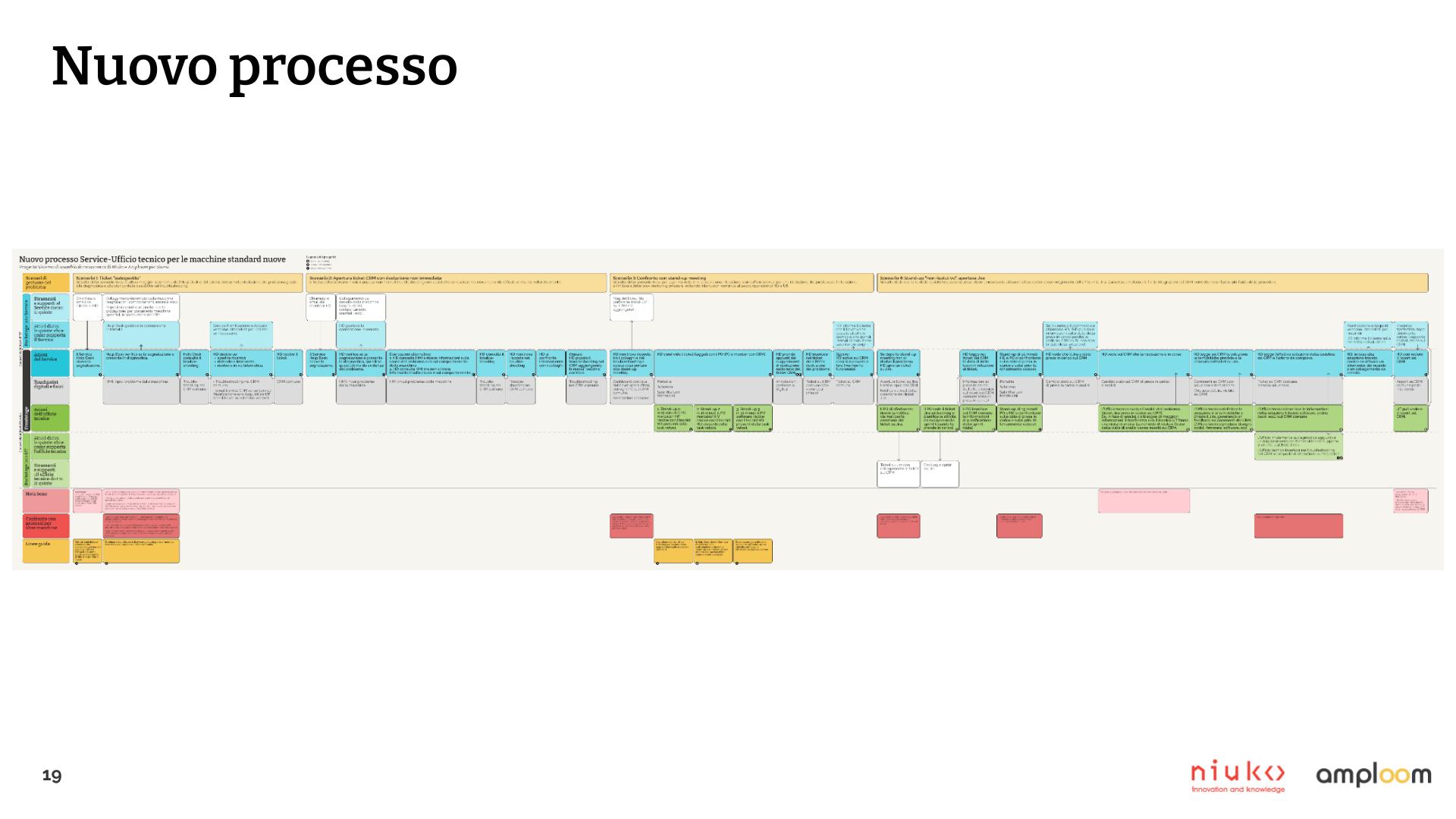
Together with Niuko, we involved seven representatives from Service and the Technical Office, along with their managers, primarily in mapping after-sales management to identify critical issues between the two departments. Based on this analysis, solutions were co-designed and then detailed in a new corporate process describing the implementation of three knowledge-sharing mechanisms.
Result
A new knowledge-sharing process between Service and the Technical Office through three enabling mechanisms
The project team developed three mechanisms to streamline collaboration between Service and the Technical Office, mapped at a corporate process level with corresponding operational guidelines. They then planned the creation and implementation of these mechanisms. Finally, the project fostered greater empathy and a sense of collaborative synergy among participants.
Using Service Design tools, we co-designed efficiency mechanisms together with the Service and Technical Office teams
Initial Challenge
Increasing Service technical autonomy and streamlining the relationship with the Technical Office
Sisma S.p.A. is a global leader in the design and production of high-precision machinery and laser systems.
The company contacted Niuko and Amploom to review their service and after-sales management and to structure the exchange of technical knowledge between two highly interdependent departments: Service and the Technical Office.
The set objective was twofold: to increase Service autonomy in resolving specific technical machinery issues, and to streamline and reduce the time the Technical Office dedicates to supporting Service, making the collaboration between the two departments more meaningful and effective for all stakeholders involved.
Strategy
Designing effective collaboration between Service and the Technical Office starting from an analysis of after-sales management
Together with Niuko, we developed a co-design and Service Design training program that involved seven participants, including Service technicians and Technical Office Product Owners, as well as the two department heads. The program consisted of 6 sessions:
a kick-off to actively involve participants and strategically define the scope of intervention;
an analysis using Service Blueprints of after-sales customer management to identify cooperation issues between departments;
the generation of multiple solutions for the identified issues, prioritized and condensed into three enabling mechanisms;
two final sessions dedicated to the detailed mapping of the new knowledge-sharing process between the two departments, specifying the practical execution of each generated mechanism;
finally, the program outputs and the mechanism implementation plan were presented to the CEO, department heads, and HR Manager, and approved.
Result
A new knowledge-sharing process between Service and the Technical Office through three enabling mechanisms
11
people involved, including operational staff, managers, HR, and CEO
2
process mappings (AS IS and TO BE)
3
new enabling collaboration mechanisms
The results of the program are:
the construction of three mechanisms aimed at streamlining collaboration between Service and the Technical Office: one related to internal meetings, one to internal information systems, and the last to the development of smart assistance tools. The defined new corporate process illustrates the execution of these three mechanisms, providing operational guidelines;
the planning for the creation and implementation of the designed mechanisms, with the assignment of responsibilities, timelines, KPIs, and cost assessments;
the active involvement of the 7 operational figures in all project phases, starting from the after-sales management analysis, allowed the participants to understand the work dynamics of their counterparts in a new way, generating empathy and a greater sense of synergy in the collaboration between the two departments.
Nicola Tezza, Human Resources Manager @ Sisma S.p.A.
"Amploom and Niuko found the right levers to improve the processes in question, creating the proper tools to effectively manage the information flow."
"From an initial analysis, it immediately emerged that it was necessary for the two areas to speak the same language, but above all to ensure that each individual department voiced its real information needs in order to satisfy the end customer.
A few weeks later, the two areas set improvement goals, which they shared and now monitor in a daily 15-minute meeting.
"
Stefano Bernardi, Technical Office Manager
"Instead, thanks to the willingness of the participants and the support and expertise of Amploom and Niuko, a constructive climate oriented toward shared problem-solving was immediately established."
"The collaboration project between Service and the Technical Office, born to respond to increasing pressure from requests on one side and the desire for greater autonomy on the other, started with some doubts about its effectiveness and fears of potential conflict between the two groups.
In just a few sessions, practical and quickly implementable methodologies were defined, which will certainly help achieve the project's initial goals. It was a positive experience that strengthened team spirit and the ability to face challenges with a common method and vision. "
Massimo Meda, Service Manager
"The program stimulated constructive dialogue, leading to the definition of concrete proposals that will certainly significantly strengthen knowledge management, information sharing, and visibility into customer issues."
"Even today, an improvement in communication between Service and the Technical Office and greater operational synergy is noticeable.
The solutions that emerged are certainly challenging but represent real opportunities to make the service more efficient, enhance internal skills, and ensure increasingly qualified support for customers.
I believe this project has fostered a major step forward in the collaboration between the Technical Office and Service."
Marco Caregaro Negrin, Maurizio Marcato, Luca Passarella, Design Group Managers
"During the activities, we consulted with our help-desk colleagues to try to reconstruct what happens when a support request arrives from a customer."
"Then, by analyzing what happens internally in these cases, we realized how demanding the work of other departments is and how much information is lost every day due to incorrect internal flows or processes. There were important moments of debate, but in the end, we strengthened the synergy between groups and are convinced that together we will improve the work environment for everyone, also benefiting end-customer support. "
"In all honesty, we approached the program with some skepticism, having tried similar paths in the past. With the support of the Amploom-Niuko team, however, we managed to uncover issues in the information exchange between Service and the Technical Office that we were unaware of. "
"Thanks to a collaborative and constructive atmosphere, we found new solutions together that will soon be implemented; however, the increased mutual awareness has already improved internal relations and strengthened collaboration between departments, with concrete benefits for our customers as well."
What is the Service Design element?
The process mappings were carried out following Service Design methodology. Specifically, the Service Blueprint was used for the analysis of after-sales management and for the design of the new process.
What's in Employee Experience Design?
The co-design of the process and knowledge-sharing mechanisms directly involved representatives from the relevant departments to generate solutions that, while improving efficiency, were primarily based on the needs of the people involved in the designed dynamics.
“>Do the challenges this organization faced seem familiar to you?
Tell us about it, and let’s discover together how we can support you in transforming your organization today into the organization of tomorrow.
×
Nuove risorse e stimoli interessanti
Attraverso le nostre risorse potrai comprendere come trasformiamo la cultura organizzativa e le esperienze delle persone con il design: immergiti in casi studio, ricevi materiali ispirativi, leggi storie dal grande impatto trasformativo.